Renewable Energy Idea Contest Prototype

Waste-to-Watts: Smart Renewable Energy from Urban Drain Gas for Sustainable Cities

A smart prototype concept for controlled drain/sewer gas collection, real-time monitoring, gas treatment, low-pressure storage, and renewable energy recovery.

Safe
45.0%

Methane CH₄ Level

38 ppm

Hydrogen Sulfide H₂S

8.2 kPa

Storage Pressure

1.14 kWh

Estimated Electricity / Day

Gas Quality Dashboard

Safety Checklist

Gas Leak DetectorON
H₂S AlarmON
Ventilation FanON
Flame ArrestorInstalled
Non-Return ValveInstalled
Emergency Shut-OffReady

Dashboard values are demo/simulation data for prototype presentation. Real deployment requires certified sensors, trained supervision, and legal permission.

Daily Energy Split

Latest Prototype Readings

Parameter Reading Status Purpose
CH₄ 45.0% Energy Available Fuel gas measurement
H₂S 38 ppm Needs Filter Toxic/corrosive gas monitoring
O₂ 1.2% Low Air Entry Air mixing and explosion-risk control
Pressure 8.2 kPa Stable Low-pressure storage monitoring

Control, Data, Safety and System Management

This section shows how the whole Waste-to-Watts prototype can be monitored and controlled from one smart control system.

Main Controller

The main controller receives sensor data, checks safety conditions, stores readings, and sends commands to system devices.

  • Microcontroller / PLC concept
  • Real-time sensor reading
  • Automatic alarm logic
  • Data logging and dashboard update

Input Data

All important system readings are collected from sensors and shown on the dashboard.

  • CH₄ methane concentration
  • H₂S toxic gas concentration
  • O₂ oxygen level
  • LEL explosive-risk level
  • Gas pressure and flow rate
  • Filter status and storage level

Output Control

The controller can manage safety and flow-control devices in the prototype system.

  • Ventilation fan control
  • Alarm and warning light
  • Emergency shut-off signal
  • Low-pressure blower status
  • Gas holder and pressure monitoring
  • Energy recovery ON/OFF status

How the Control System Works

Step Control Action Purpose
1 Read sensor data Collect CH₄, H₂S, O₂, LEL, pressure and flow data
2 Analyze safety status Compare readings with safe operating limits
3 Update dashboard Show live system condition to the operator
4 Store data log Save readings for research and performance analysis
5 Trigger safety response Activate alarm, ventilation, or emergency shut-off when unsafe
6 Report energy output Calculate methane volume, thermal energy and electrical output

Smart Safety Modes

Normal Mode

Gas quality is acceptable, pressure is stable, and the system continues monitoring and energy recovery.

Warning Mode

H₂S, oxygen, pressure or flow values move toward unsafe range; alarm and operator notification are activated.

Emergency Mode

Unsafe gas condition is detected; the system stops energy recovery, triggers alarm, and activates emergency control response.

Control System Data Equation

At each time step, the controller stores a complete system data record:

D(t) = [CH₄(t), H₂S(t), O₂(t), LEL(t), P(t), Q(t), Vg(t), E(t), SafetyStatus(t)]

The system status can be represented as:

SafetyStatus = f(CH₄, H₂S, O₂, LEL, Pressure, Leakage)

This makes the prototype useful for research, safety analysis, performance measurement, and renewable-energy output estimation.

All Control Units, Data Dashboard and ON/OFF Switches

This page works as a simulated control-room interface for the Waste-to-Watts prototype. It shows all units, live data, device status, alarms, and switch controls in one dashboard.

Control Panel Login

Login is required before opening the full control panel.

Demo login: username admin, password 12345

Complete Gas Flow Data Across the System

Raw → Treated → Storage → Energy
0.20 m³/h
0.17 m³/h
85%
1.6 kPa
Flow Stage Flow Rate Pressure Loss / Drop Status
1. Collection Hood / Raw Gas Line 0.20 m³/h 8.2 kPa Baseline Receiving Gas
2. Condensate Trap / Moisture Separator 0.19 m³/h 7.8 kPa 5% Moisture Removed
3. H₂S Removal Filter 0.18 m³/h 7.3 kPa 10% Filter Load
4. Particulate Filter + Low-Pressure Blower 0.17 m³/h 6.9 kPa 15% Clean Flow
5. Gas Holder Storage Inlet 0.17 m³/h 6.6 kPa 17% Stored
6. Regulator to Energy Recovery Unit 0.12 m³/h 5.8 kPa 40% Usable Output
Formula: Flow Efficiency = (Treated Gas Flow ÷ Raw Gas Flow) × 100. Pressure Drop = Raw Line Pressure − Output Line Pressure.

Waste-to-Watts Process Flow

A more gorgeous and realistic workflow view showing raw sewer gas moving from drain source to collection, monitoring, treatment, storage and energy recovery.

1
Drain / Sewer Source

Organic urban waste decomposes in low-oxygen drain or sewer conditions.

Raw gas: CH₄, CO₂, H₂S, moisture
Role: Source generation
2
Gas Collection Point

A sealed hood captures gas from the headspace and reduces air entry.

Control: Sealed collection
Protection: Condensate trap
3
Gas Monitoring

Sensors check methane, toxic gas, oxygen and explosive-risk level.

CH4: 45.0%
H2S: 38 ppm
O2 : 1.2%
Data: CH₄, H₂S, O₂, LEL
Output: Alarm + logging
4
Gas Treatment

Moisture, hydrogen sulfide and particulates are removed before use.

Units: Moisture + H₂S + filter
Goal: Clean treated gas
5
Storage / Energy Recovery

Treated gas is stored at low pressure and used for energy output.

Output: Heat / electricity
Status: Renewable energy

Drain / Sewer Source

Raw gas is generated from biodegradable waste decomposition.

Raw gas generation

Black particles show raw gas flow. Golden particles show treated gas flow.

Drain / Sewer Gas Collection, Monitoring, Treatment and Energy Recovery

This section follows your system architecture: source, collection, monitoring, treatment, storage, safety system, communication, and energy recovery.
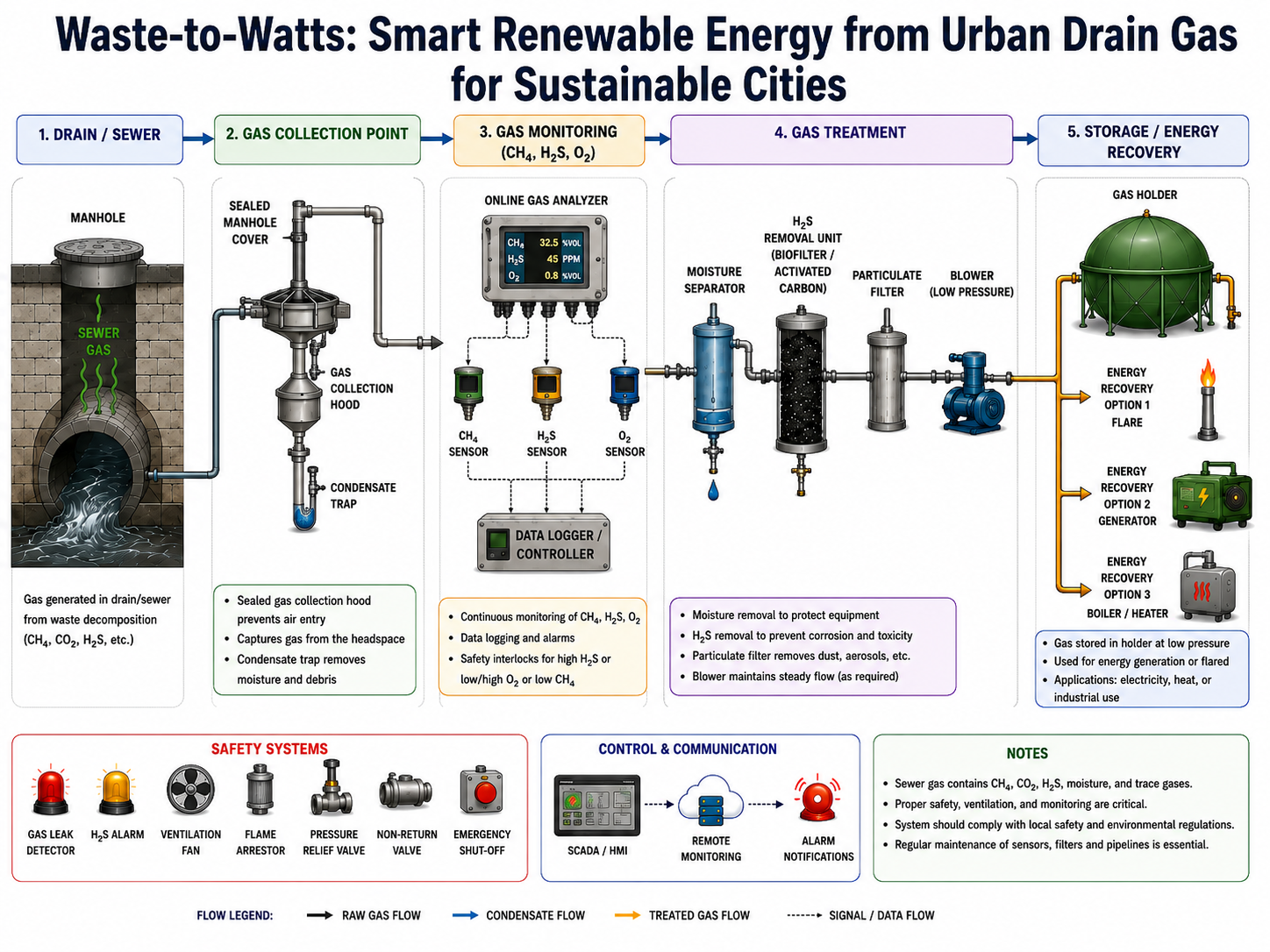
Waste-to-Watts architecture diagram
1
Drain / Sewer

Gas is produced from organic waste decomposition.

2
Gas Collection Point

Controlled collection hood captures gas from headspace.

3
Gas Monitoring

Sensors monitor CH₄, H₂S, O₂, and LEL risk.

4
Gas Treatment

Moisture, H₂S, and particulates are reduced.

5
Gas Holder

Cleaned gas is stored at low pressure.

6
Energy Recovery

Gas can be used for flaring, heating, or generator testing.

7
Safety Systems

Alarm, ventilation, flame arrestor, and emergency shut-off.

8
Control System

Dashboard, data logger, and remote monitoring concept.

Section-wise Project Summary

Context

Bangladesh’s urban areas produce large amounts of wastewater, sewage sludge, food waste, and biodegradable organic waste every day. In drains and sewer lines, these wastes decompose under low-oxygen conditions and produce gases such as methane, carbon dioxide, hydrogen sulfide, water vapor, and other trace gases.

Usually, this gas escapes into the environment, causing bad odor, health risks, fire hazards, and greenhouse gas emissions. However, methane is an energy-rich gas and can become a renewable energy source if safely handled.

Objective

The objective of this project is to develop a smart prototype system that can collect gas from a controlled drain or sewer point, monitor its composition, remove harmful impurities, store it safely at low pressure, and convert it into useful renewable energy for heating, cooking demonstration, or small-scale electricity generation.

Innovation Summary

The proposed system includes a gas collection point, gas monitoring unit, moisture separator, hydrogen sulfide removal filter, particulate filter, low-pressure gas holder, pressure regulator, and energy recovery unit. The monitoring system measures methane, hydrogen sulfide, oxygen, and explosive-risk level. The innovation is that the project treats urban drain gas not only as a pollution and safety problem but also as a recoverable renewable-energy resource with mathematical modelling for gas flow, methane volume, thermal energy, electrical output, treatment efficiency, and carbon-emission reduction.

Renewable Energy Calculation

The final electrical output depends on gas volume, methane fraction, treatment efficiency, and generator efficiency.

Gas flow rate:

Qg = Vg / t

Methane volume:

VCH₄ = Vg × yCH₄

Thermal energy:

Ethermal = VCH₄ × 35.8 MJ/m³

Electrical output:

Eelectric = (Vg × yCH₄ × 35.8 / 3.6) × ηt × ηg

Example

  • Collected gas: 1.20 m³/day
  • Methane fraction: 45%
  • Methane volume: 0.54 m³/day
  • Thermal energy: 5.37 kWh/day
  • With 85% treatment efficiency and 25% generator efficiency:
  • Electrical output: 1.14 kWh/day

These values are theoretical and must be validated through safe prototype testing.

Challenges and Action Plan

Implementation Challenges

  • Variable methane concentration in drain/sewer gas
  • Low and unstable gas pressure
  • Presence of toxic hydrogen sulfide (H₂S)
  • Moisture accumulation in gas pipelines
  • Corrosion of metal parts and equipment
  • Gas leakage risk
  • Fire and explosion safety concerns
  • Public health and environmental safety issues
  • Need for permission for field testing
  • Requirement for continuous monitoring and maintenance

Action Plan

  • Develop a laboratory-scale prototype
  • Calibrate gas sensors for CH₄, H₂S, O₂, and explosive-risk level
  • Conduct safe field observation under supervision
  • Test gas collection from a controlled drain/sewer point
  • Remove moisture using a moisture separator
  • Remove H₂S using a gas filter
  • Test pressure stability in low-pressure storage
  • Add flame arrestor, non-return valve, pressure relief valve, and emergency shut-off
  • Measure gas flow rate, methane volume, treatment efficiency, and energy output
  • Analyze energy output and carbon-emission reduction potential

Energy Output Calculator

Use this dashboard calculator to estimate renewable energy output from your prototype data.

1.20 m³/day
0.54 m³/day
5.37 kWh/day
1.14 kWh/day

Safety-first prototype design

This website presents the concept as a supervised university prototype. Field testing should only be done with institutional permission, trained supervision, certified gas detectors, PPE, ventilation, emergency shut-off, low-pressure storage, and legal compliance.

Add Your Team Information

Replace the placeholder details with your university, team name, department, phone, and email before submission.

Team Name: [Your Team Name]

Project: Waste-to-Watts

University: [Your University Name]

Department: [Your Department]

Email: your.email@example.com

Website Sections Included

  • Hero section with final title
  • Live-style dashboard
  • Architecture section
  • Proposal summary
  • Mathematical model
  • Challenges and action plan
  • Safety and team information
  • Interactive energy calculator